
Strategy for AI, autonomy and national security
Propelling technology. Humans matter.
Omnia Tech is the consultancy of Tucker Hamilton, the first pilot in aviation history to fly alongside a high-performance uncrewed system powered by AI, and the Air Force’s first Chief of AI Test and Operations. It gives companies building autonomy a senior strategy seat.
Technology matters.
A chief strategy seat, without the hire.
Most companies building for national security do not need another deck. They need someone senior in the room on the days that decide things, who knows how government tests a new technology and how it buys one. Omnia Tech takes that seat on retainer and works alongside the founders.
-
01
Finding the right door
Test organizations, innovation units and program offices do not move at the same speed. Knowing which one is funded this year, and who inside it cares about your problem, is where an engagement usually starts.
-
02
Ready for the room
An introduction only helps a team that can answer the hard questions that follow it. We rehearse those questions first, so the meeting is spent on the technology.
-
03
Tested like it matters
Whether anyone trusts an autonomous system comes down to how it was tested. Tucker ran AI test and operations for the Air Force and brings that discipline to a product roadmap.
-
04
Small against the incumbents
A small team answers faster and carries less bureaucracy than the companies it bids against. The strategy is to make that the reason a program chooses you.
The first six companies to give him that seat have grown 10 to 30x, from a combined valuation of $80M to well over $1B.
The question
National security matters.
“How do humans perform when the margin for error disappears?”
It used to be a cockpit question. Now that AI shares decisions with people in business and in government, it belongs to every leader, and it is the one Omnia Tech is hired to help answer. We take on a small number of companies at a time.
- Leadership in high-consequence environments
- Decision-making under pressure
- Trust and accountability in autonomous systems
- Organizational performance in the face of technological disruption
Artificial intelligence matters.
The wave is upon us.
What language models have shown so far is the small part. AI joined to physical machines is going to change construction, firefighting and the way governments work. Tucker has watched the early version of it from closer than almost anyone.
“The challenge facing leaders is no longer whether to adopt advanced technology, but how to do so while preserving judgment, trust, and accountability.”
Tucker’s work sits at that point, inside the companies building these systems and not in the commentary about them.
“As our world races forward into an era defined by AI, autonomy, and renewed great power competition, one truth remains…”
Humans still matter.
AI now shares decision space with people. The work is adopting it while judgment, trust and accountability stay with a person.
The human in the seat.
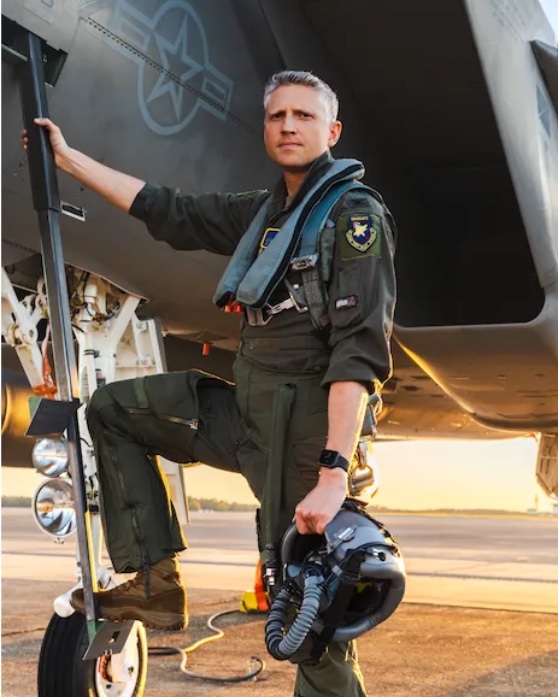
Tucker Hamilton spent more than twenty years in the Air Force as a fighter pilot, an experimental test pilot and a commander. He now advises the companies building what he used to test.
- AI policy
- On the United States delegation in dialogue with China on the ethics of AI and autonomy.
- Research
- Helped establish the AI Accelerator that the Department of the Air Force runs with MIT.
- Command
- Commanded the F-35 Integrated Test Force, the largest flight test organization in modern aviation.
- Flight test
- More than 300 flight test missions as an experimental fighter test pilot, in more than 30 aircraft including all three variants of the F-35.
- Combat
- 450 combat hours across 80 combat missions over Afghanistan.
- Education
- Founder and CEO of the Aerospace Robotics Competition, a national drone competition for middle and high school students.
Start a conversation.
Tell us what you are building and where it is stuck.